Wolf monitoring · Wolf management
Large carnivore conflict management – science-based and practical
Advice, monitoring and knowledge transfer on living with wolves.

Michael Ohlhoff
Michael Ohlhoff is an Academic Wildlife Manager (University of Natural Resources and Life Sciences, Vienna) who studied in Bremen and is an experienced practitioner in wildlife management. As a wolf advisor to the NLWKN and a member of the EU project LIFE Wild Wolf, he works at the interface between science, hunting practice and conflict management with large carnivores.
He is a falconer, a certified game meat sommelier and a lecturer in the wolf working group of the Bavarian Hunting Association (BJV) and at the German Hunting Academy (Deutsche Jagdakademie). As an author, he focuses on practical, animal-welfare-compliant solutions for human–wildlife conflicts, particularly those involving wolves.
- Wolf advisorLower Saxony State Agency for Water Management, Coastal and Nature Conservation (NLWKN)
- Academic Wildlife ManagerUniversity of Natural Resources and Life Sciences, Vienna (BOKU)
- DJA JagdwirtGerman Hunting Academy (Deutsche Jagdakademie), 2025
- Certified Game Meat SommelierButchers’ Trade Training Centre Augsburg, 2025
Next event
06.–07.03.2027
Sat 9 am – 6 pm · Sun 9 am – 3 pm
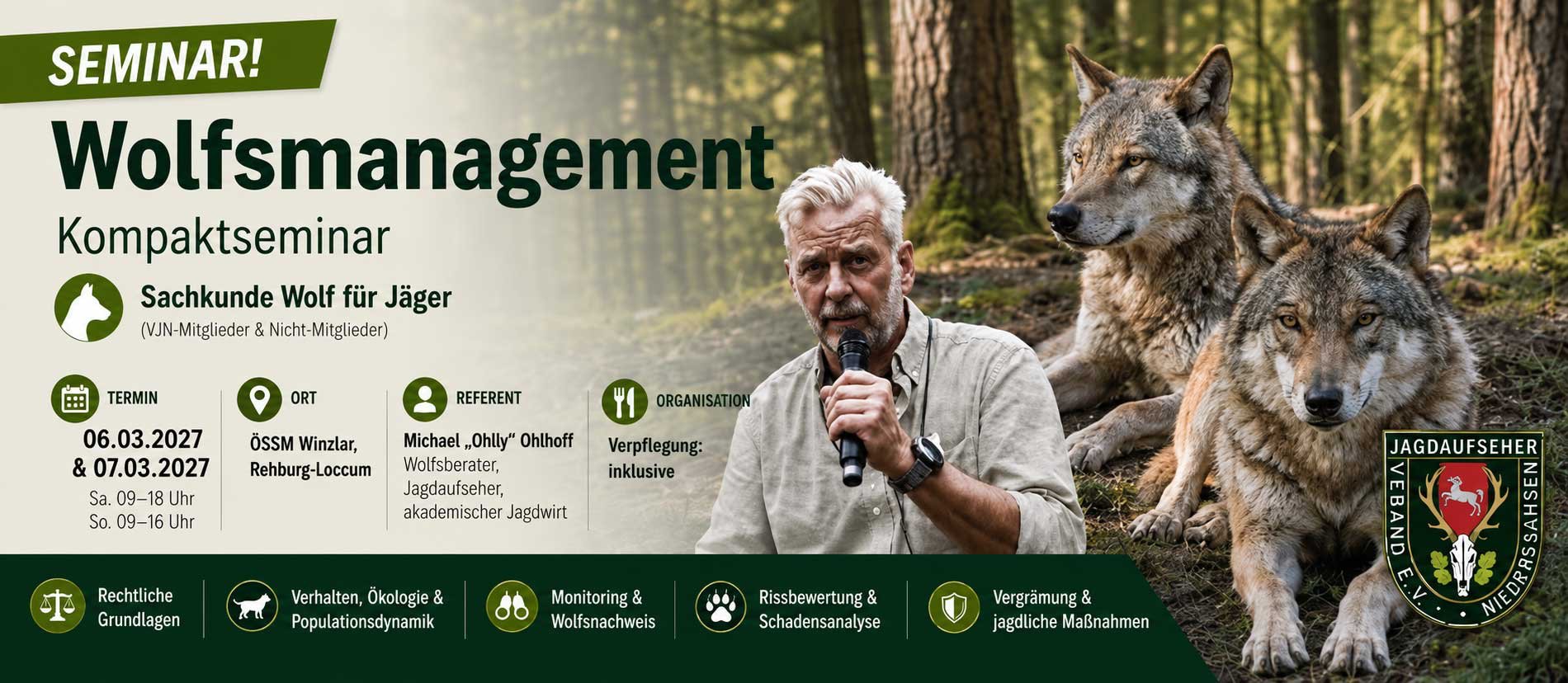
Wolf management – expertise for hunters and game wardens
Compact seminar (in German) · €150 members / €170 non-members · coffee and snacks included · max. 30 participants
Venue: ÖSSM Winzlar, Hagenburger Straße 16, 31547 Rehburg-Loccum, Germany
Organiser: Lower Saxony Game Wardens’ Association (Verband der Jagdaufseher Niedersachsen e. V., VJN)
- Legal framework
- Behaviour, ecology & population dynamics
- Monitoring & wolf detection
- Kill assessment & damage analysis
- Hazing & hunting measures
Topics
Wolf monitoring
Recording and assessing evidence of wolves according to the national monitoring standards.
Conflict management
Managing conflicts between wolves, livestock farming, hunting and the public.
Aversive conditioning
Hazing wolves that show conspicuous behaviour: methods, legal situation and international experience.
Talks and training
Talks, seminars and training for hunting associations, authorities, organisations and livestock keepers.

New book · published December 2026
Aversive Konditionierung
Wolf (Canis lupus)
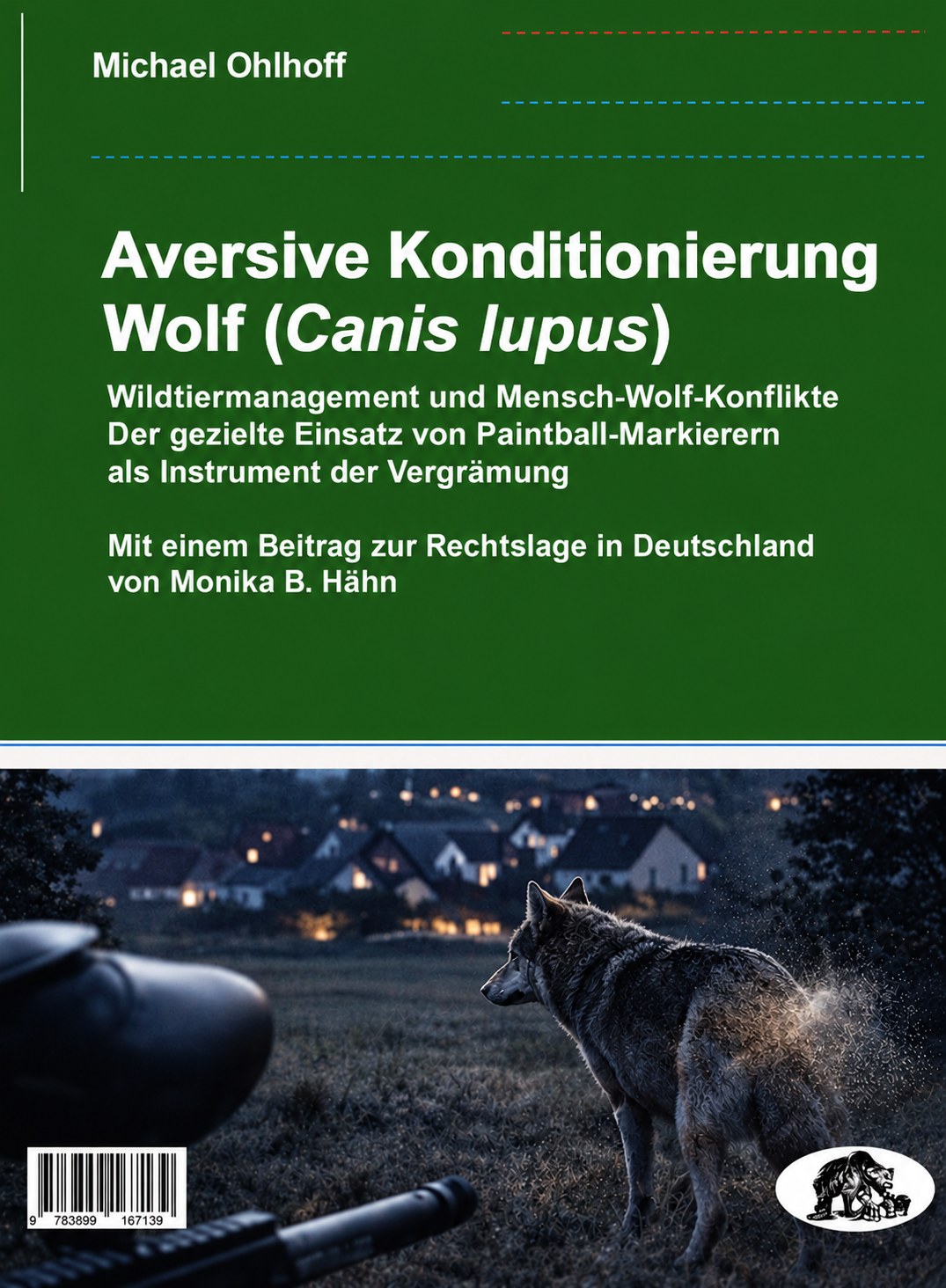
Wildlife management and human–wolf conflicts: the targeted use of paintball markers as a hazing tool
By Michael Ohlhoff. With a contribution on the legal situation in Germany by Monika B. Hähn, lawyer and notary, Lübbecke.
Bear Family Records · paperback · 270 pages · German/English · ISBN 978-3-89916-713-9
Abstract
The increasing presence of wolves (Canis lupus) in human-dominated landscapes poses new challenges for wolf management. Targeted management measures may become necessary, particularly for individuals that develop reduced wariness of humans or repeatedly show undesirable approach behaviour. Aversive conditioning aims to promote avoidance of humans and to change undesirable behaviour patterns in the long term by linking certain behaviours with unpleasant stimuli.
Read more
This work examines the possibilities and limitations of paintball markers as a tool for the aversive conditioning of wolves. It focuses on the behavioural-biological principles, international experience with non-lethal deterrence measures, and the technical and ballistic properties of different marker and projectile systems. It also considers the requirements for engagement distance, target area, safety, animal welfare, the qualification of operating personnel and documentation. In addition, the legal framework in Germany is assessed.
The study concludes that paintball markers are, in principle, suitable as a tool for aversive conditioning because of their targeted effect and the adjustable intensity of the stimulus applied. Prerequisites are a sound assessment of the individual wolf’s behaviour, suitable and controllable operating conditions, appropriately trained personnel, and standardised implementation and documentation. Scientific evidence on the long-term effectiveness of such measures in free-ranging wolves is still limited. In particular, there is a lack of sufficiently robust studies demonstrating lasting behavioural change under different operating conditions.
Within a graduated approach to wolf management, paintball markers can be a non-lethal option when preventive measures alone are not sufficient and the aim is to influence the behaviour of the individual concerned. The decisive criterion for assessing success is not the immediate flight or avoidance response, but a change in behaviour towards humans that can be demonstrated beyond the individual intervention.
Abstract (DE)
Die zunehmende Präsenz von Wölfen (Canis lupus) in anthropogen geprägten Landschaften stellt das Wolfsmanagement vor neue Herausforderungen. Insbesondere bei Individuen, die eine verminderte Scheu gegenüber Menschen entwickeln oder wiederholt unerwünschtes Annäherungsverhalten zeigen, können gezielte Managementmaßnahmen erforderlich werden. Die aversive Konditionierung verfolgt das Ziel, durch die Verknüpfung bestimmter Verhaltensweisen mit unangenehmen Reizen ein Meideverhalten gegenüber Menschen zu fördern und unerwünschte Verhaltensmuster nachhaltig zu verändern.
Die vorliegende Arbeit untersucht die Einsatzmöglichkeiten und Grenzen von Paintball-Markierern als Instrument der aversiven Konditionierung bei Wölfen. Im Mittelpunkt stehen die verhaltensbiologischen Grundlagen, internationale Erfahrungen mit nicht-letalen Vergrämungsmaßnahmen sowie die technischen und ballistischen Eigenschaften unterschiedlicher Markierer- und Projektilsysteme. Darüber hinaus werden die Anforderungen an Einsatzdistanz, Zielregion, Sicherheit, Tierschutz, Qualifikation des Einsatzpersonals und Dokumentation betrachtet. Ergänzend erfolgt eine Einordnung der rechtlichen Rahmenbedingungen in Deutschland.
Die Untersuchung kommt zu dem Ergebnis, dass Paintball-Markierer aufgrund ihrer gezielten und hinsichtlich der eingesetzten Reizintensität beeinflussbaren Wirkung grundsätzlich als Instrument der aversiven Konditionierung infrage kommen. Voraussetzung sind eine fundierte Bewertung des individuellen Wolfsverhaltens, geeignete und kontrollierbare Einsatzbedingungen, entsprechend geschultes Personal sowie eine standardisierte Durchführung und Dokumentation. Die wissenschaftliche Evidenz zur langfristigen Wirksamkeit derartiger Maßnahmen bei freilebenden Wölfen ist bislang begrenzt. Insbesondere fehlen ausreichend belastbare Untersuchungen, die eine dauerhafte Verhaltensänderung unter unterschiedlichen Einsatzbedingungen nachweisen.
Paintball-Markierer können innerhalb eines abgestuften Wolfsmanagements eine nicht-letale Handlungsoption darstellen, wenn präventive Maßnahmen allein nicht ausreichen und eine Verhaltensbeeinflussung des betreffenden Individuums angestrebt wird. Entscheidend für die Bewertung des Maßnahmenerfolgs ist dabei nicht die unmittelbar ausgelöste Flucht- oder Meidereaktion, sondern eine über den einzelnen Einsatz hinaus nachweisbare Veränderung des Verhaltens gegenüber Menschen.
Recent publications
Waidgerechtigkeit am Limit – Der Wolf und die Jagd in Deutschland zwischen Schutzauftrag und Jagdpraxis
Ohlhoff, M. (2026): Waidgerechtigkeit am Limit – Der Wolf und die Jagd in Deutschland zwischen Schutzauftrag und Jagdpraxis. Jagdwirt-Alumni, 21.03.2026 (online).
Warum Wolfsmonitoring so wichtig ist
Ohlhoff, M. (2025): Warum Wolfsmonitoring so wichtig ist. JAGD IN BAYERN 11/2025, S. 16–21.
Rückblick Wolfsschulung
Ohlhoff, M. (2025): Rückblick Wolfsschulung. JAGD IN BAYERN 11/2025, S. 52–53.
In the media
When you play the video, it is loaded from YouTube (Google) and data is transferred. More in our privacy policy.
ARD · Y-Kollektiv
Wolf vs. Schäfer – Wie gefährlich ist der Wolf in Deutschland? (German)
Documentary in German, 22 min · 25 Aug 2025
Nordwest-Zeitung online · 22 May 2026
Statistik vs Gerüchte: Wie viele Wolfsangriffe gab es in der Wesermarsch tatsächlich?
Report, NWZonline, Wesermarsch (German).
Nordwest-Zeitung online · 8 May 2026
Neues Jagdgesetz: Jäger aus der Wesermarsch warnen vor praxisfernen Wolfsregeln in Niedersachsen
Report, NWZonline, Wesermarsch (German).
Hamburger Abendblatt · 30 April 2026
Mit Paintball-Pistolen auf Wölfe schießen? Das sagt ein Experte
Lepél, S.: interview, Hamburger Abendblatt online, Harburg district (German).
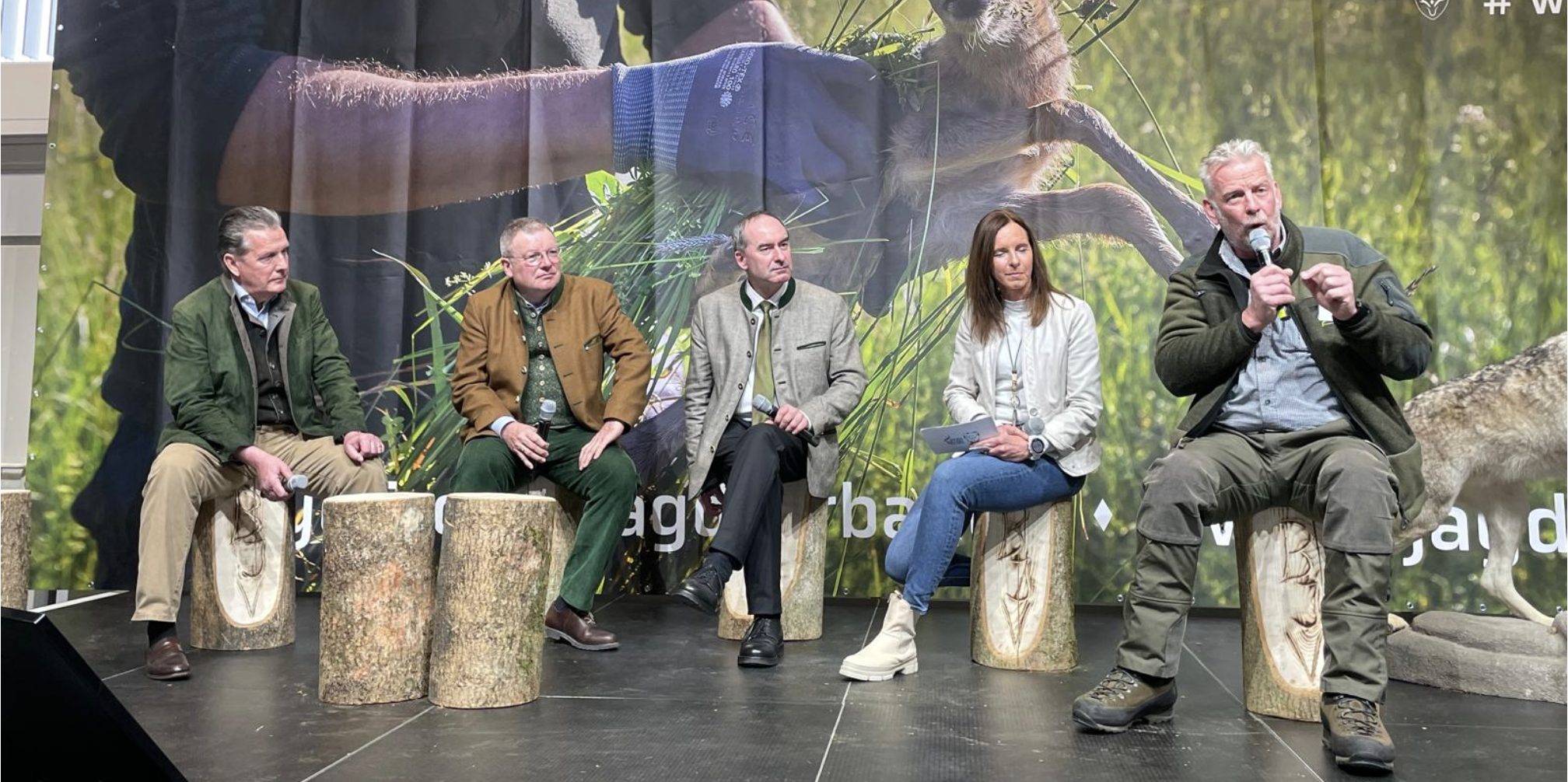
Talks and training
For hunting associations, authorities, organisations and livestock keepers.
Feedback
What participants say
Excerpts from the anonymous evaluations of the wolf training courses for the Bavarian Hunting Association (BJV) and the Lower Saxony Gamekeepers’ Association (Verband der Jagdaufseher Niedersachsen, VJN), and from feedback by local hunters’ associations (Jägerschaften) and other organisers, translated from German.
397
responses from 21 training sessions, 2024 to 2026
96 %
top grade for the speaker’s enthusiasm and motivation (“kept me attentive throughout the course”)
93 %
top grade: content presented clearly and understandably
“In a very informative and detailed talk, he first introduced the participants to the biology of the wolf and to the current issues surrounding its return. … Once again he gave us a whole afternoon of his time and explained the subject of the wolf with great enthusiasm. He passed on the enthusiasm he brings to his work to every single participant.”
Seminar leader, Federal Volunteer Service (BFD) Regional Office North – education seminar for volunteers, Cuxhaven-Sahlenburg, October 2025
“Mr Ohlhoff gave a four-hour talk that was very well founded professionally and balanced with regard to how we deal with the wolf. … I am well aware how difficult and charged the subject is. That is precisely why a balanced view of the situation is so important.”
Organiser, talk for a nature conservation and hunting authority, Lower Saxony
“I think it’s fantastic how you handle the subject and present it – it was very accessible. Above all, you can tell how passionate you are about the subject, and you manage to convey that enthusiasm while still approaching the ‘delicate’ subject of the wolf objectively.”
NABU Regional Office Elbe-Weser, talk for the NABU group Lilienthal
“This seminar was one of the most interesting [the association] has offered in recent years. The information on the wolf as a species was entertaining and seasoned with a healthy dose of sarcasm, criticism and plenty of humour – exactly the right mix to stay awake and attentive even after several hours.”
Participant, wolf training 2024
“I am hard to impress, but this training deserves only one verdict: highly recommended all round – for absolutely anyone interested in wolves, whether or not they hold a hunting licence. … I have rarely seen a course leader with such credible, authentic expertise who presents it so nimbly and clearly, with a touch of humour, and keeps the participants engaged for many hours.”
Participant, wolf training 2024
“Michael Ohlhoff’s neutrality on the subject of the wolf, and the knowledge conveyed so well as a result, instead of simply demonising it … This helps hunters to do well-founded public relations work.”
Participant, wolf training, October/November 2024
“As for the seminar itself, it was very good, and Mr Ohlhoff is certainly the best speaker on this subject.”
Participant, wolf training, August 2025
“Vivid images, professionally neutral and extremely competent.”
Participant, VJN wolf training, October 2026
“You could listen to Olly for days! Very lively, entertaining and with wide-ranging knowledge.”
Participant, wolf training, September 2024